
Discovery research into what makes Race for Impact fundraisers connect with a cause, and how to talk to them about it.
We’re getting ready to implement some experiments based on this, excited to see these insights come to life!
– Kevin Rassool, Tech lead
Context
A 2-week discovery project for High Impact Athletes.

High Impact Athletes direct donations to the most effective charities in the world — organisations vetted by independent evaluators for how much good they do per dollar.
Race for Impact is their partnership with HYROX, the fitness racing series. Racers buy a charity ticket and commit to fundraising for one of five HIA-vetted cause funds: Global Health, Mental Health, Women’s Empowerment, Animal Welfare or Climate Solutions.
It’s an unusual ask. For most racers this is their first encounter with these charities, their first encounter with effective giving, and often their first time fundraising at all. They’re raising money for organisations they’ve never heard of, chosen on grounds they’ve never come across.

Challenge
How do you get an emotion-led audience to connect to a cause built on rational, evidence-led selection?
HIA came to me with a wording question: should impact be expressed as years of depression averted, or as lives improved?
Underneath it sat a bigger one. Effective giving makes a rational case — this charity does more good per dollar than that one — but the people signing up were making an emotional decision in a matter of minutes. Nobody knew which of those two things was doing the work, or whether either was landing at all.
Answering the wording question meant understanding the audience first.

Approach
Background research
I started with what HIA already had: previous research, outcomes, open questions, and everything they’d been debating internally.
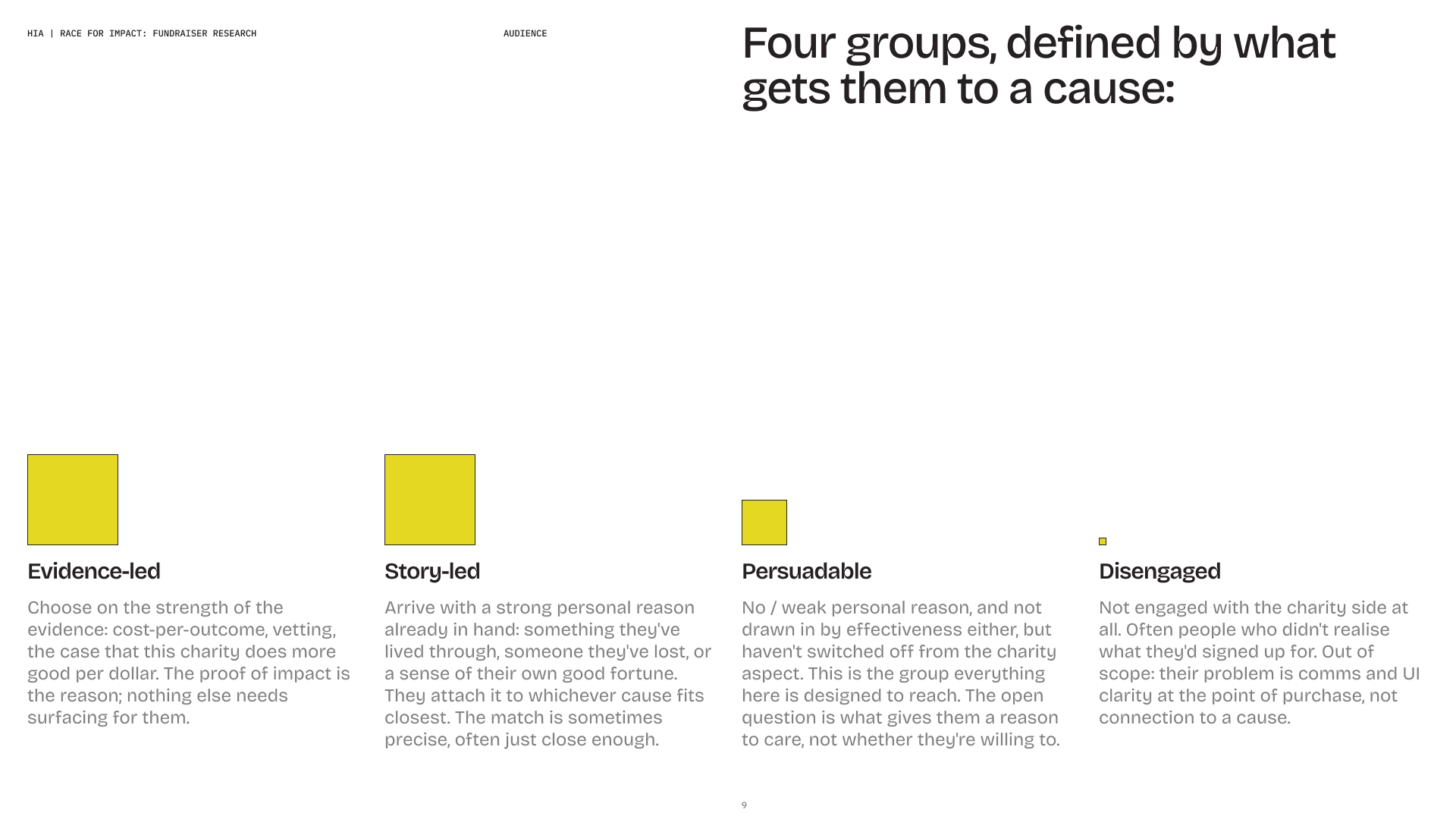
That defined the shape of the problem. Two things had to hold before a racer would fundraise — trust that the money would be well spent, and connection to the cause they’d chosen. It also gave me a working model of the audience, which I split into four groups by what actually gets them to a cause: evidence-led, story-led, persuadable, and disengaged.
The persuadable group became the target: they had no obvious personal reason to fundraise and so would be looking into the causes to understand which they connected with most.
Data analysis
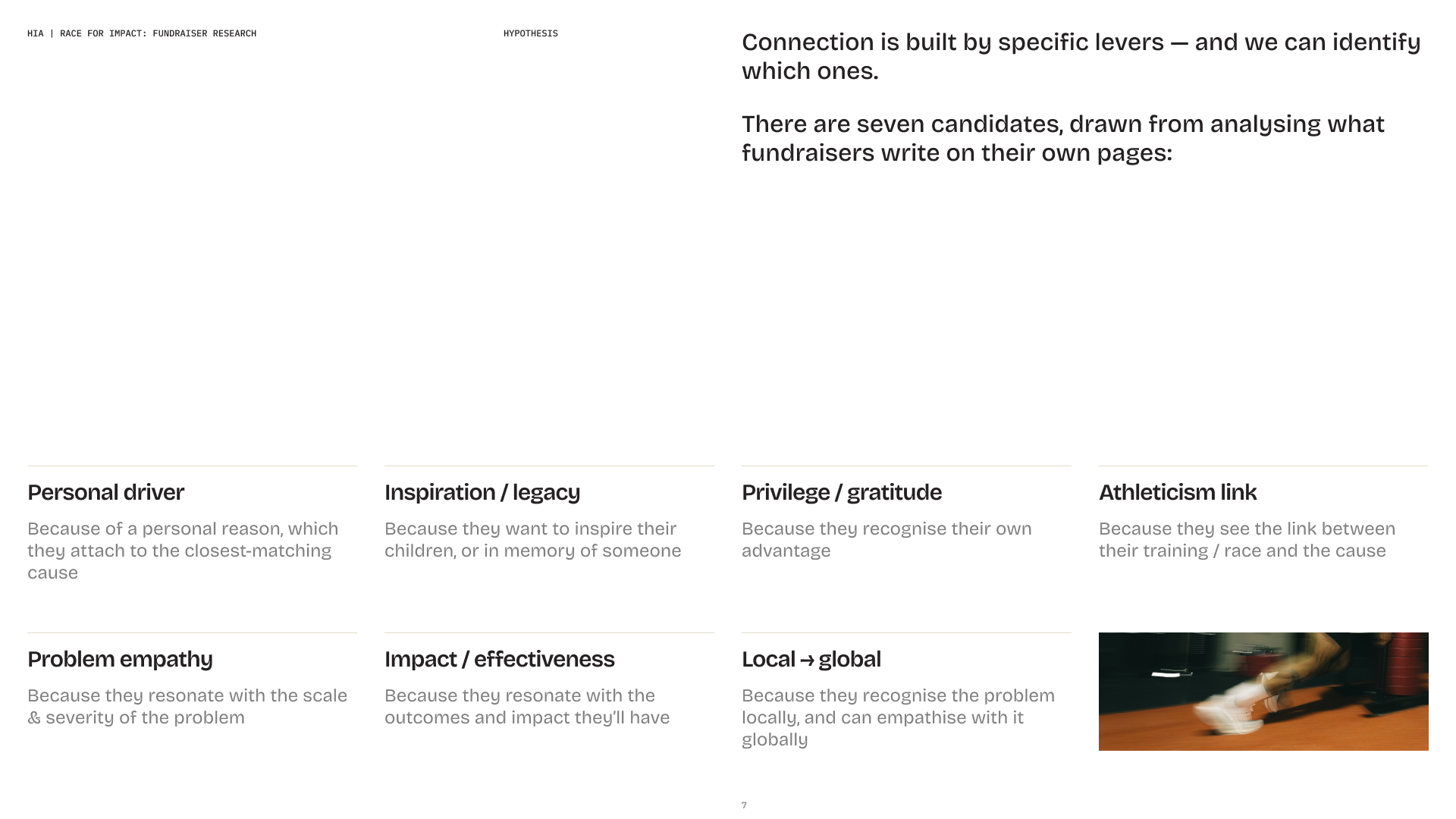
Rather than invent the connection levers from theory, I scraped and analysed the custom messages fundraisers had written on their own pages. What reasons did people actually give, unprompted, when nobody was asking?
Seven levers came out of it: personal driver, inspiration and legacy, problem empathy, impact and effectiveness, athleticism, local-to-global, and privilege.
This came with a catch. Only around 10% of fundraisers write anything custom at all, so it skewed toward the most expressive and most engaged — precisely the people who arrive with a reason already. Which meant these levers were hypotheses drawn from the wrong population, and needed testing against real racers rather than assumed.
Assumptions and learning goals
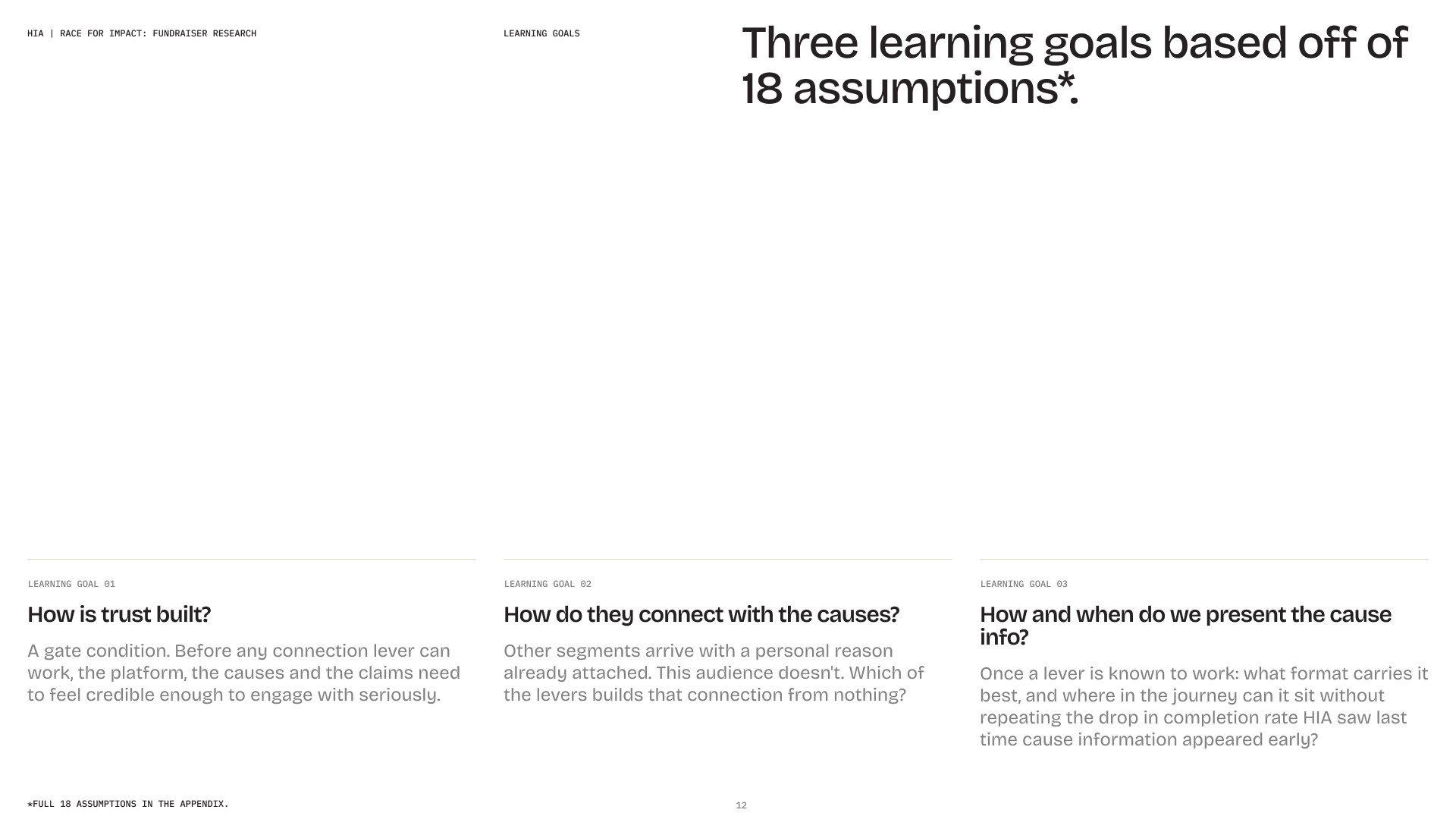
I mapped out every assumption underneath the levers and the trust question, and grouped them into three learning goals: how trust is built, how racers connect with the causes, and how and when to present cause information.
That gave the research a spine. Every question in the guide, and every element of the stimulus, mapped back to something specific we were trying to find out.
Interviews
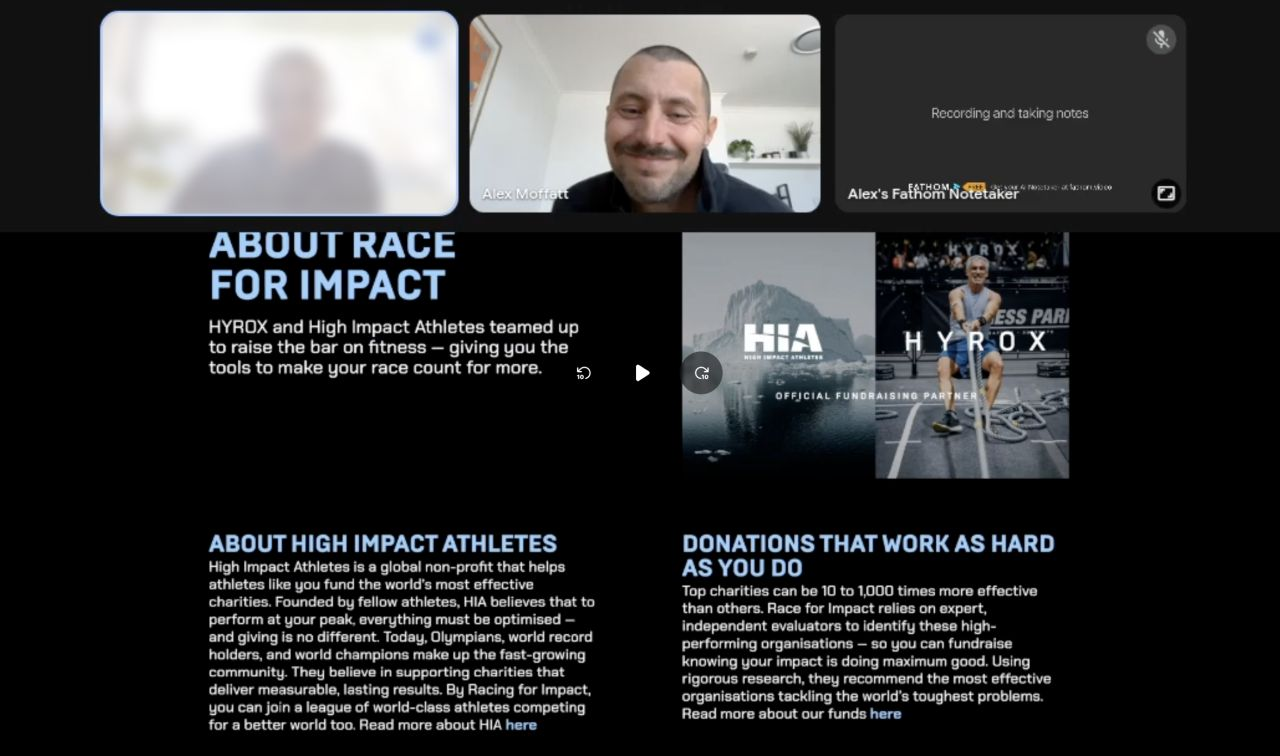
Five sessions with racers signed up to HYROX Melbourne.
Why interviews, and why with something to react to: asking hypothetical questions about charity is close to useless. People consistently believe themselves more altruistic than they are, and will happily tell you a message moved them when it didn’t. So every session was built around reactions to real material rather than opinions about ideas.
Each ran in three parts:
Recall — what racers remembered of their own sign-up, unprompted. This was how I established what had actually got through before showing them anything, and it’s where the central finding first surfaced.
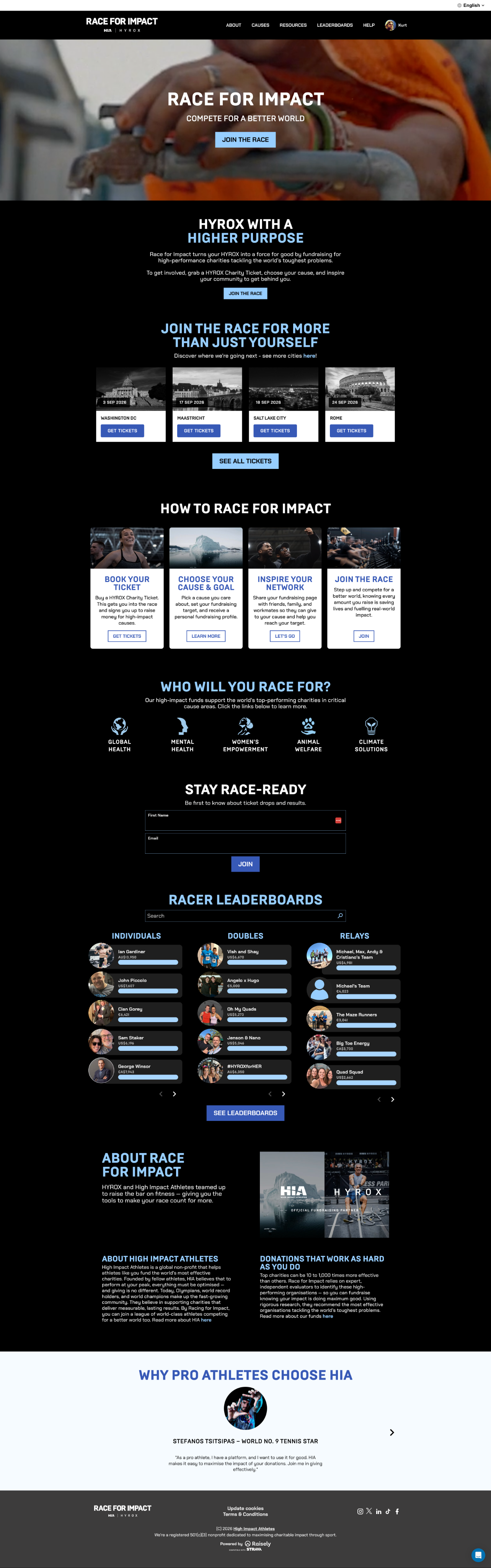
The existing journey — walking the live pages together, to see what registers, what gets misread, and what gets skipped entirely.
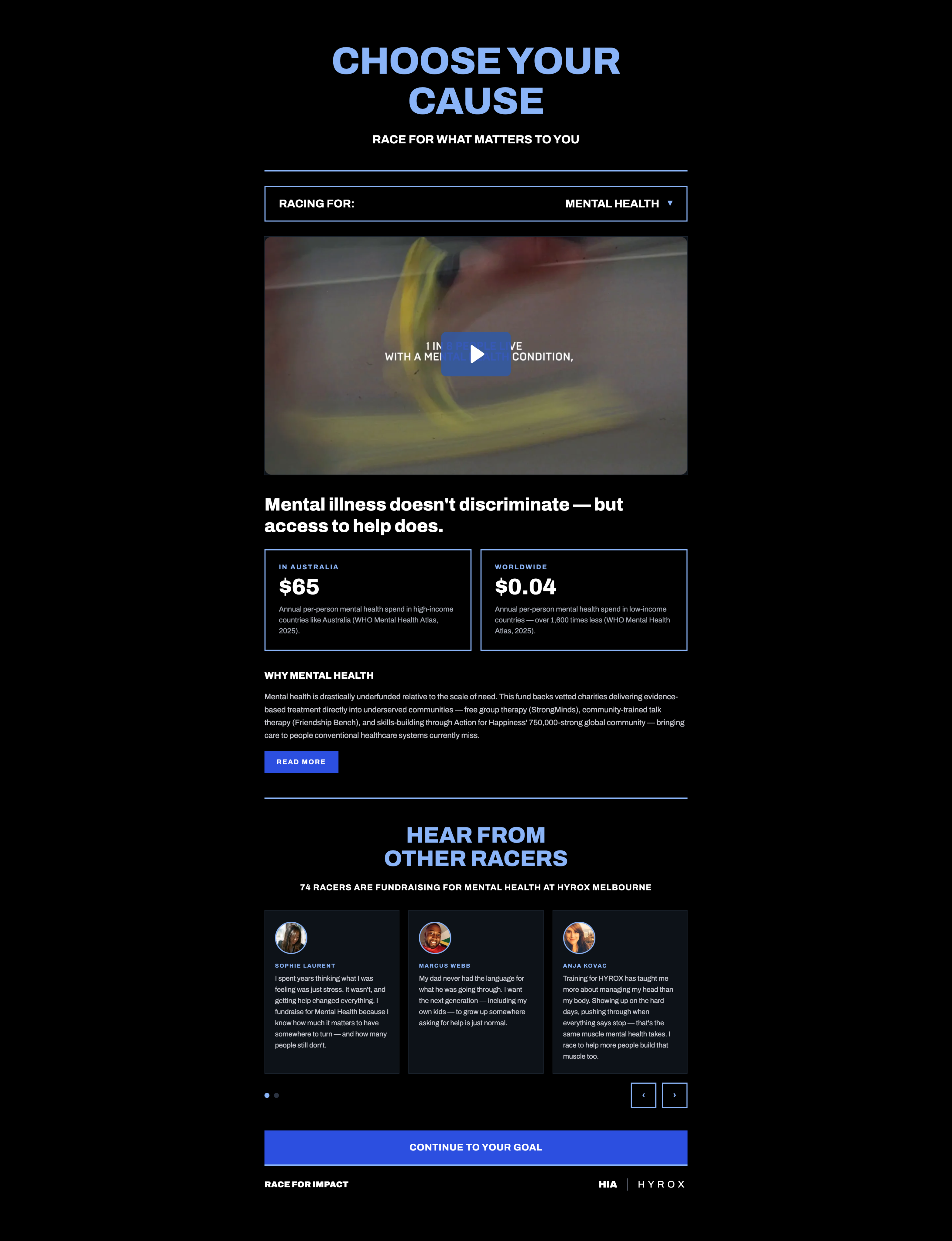
The prototype — an interactive version of the cause-selection experience I built with the levers designed in and every content block toggleable, so individual levers could be swapped live and tested one at a time.
Trust, confidence and passion were scored 1–10 at three points: cold, after the live pages, and after the prototype.
Synthesis
I pulled the findings into a strategy narrative — four learnings, each with a design principle HIA could apply to any communication with a fundraiser, not just the page I’d been briefed on.
Learnings
Racers don’t go looking — you have to put it in front of them.
Racers choose a cause in minutes and don’t hunt for more. Most had never seen the content that would have informed the choice.
→ Give racers the information that matters at the moment it matters. At cause selection, that’s the problem and the impact.
I wish I saw [the cause info] first... we joined straight away without actually thinking of the fundraising part.
– Participant 02
Everyone has a connection — the job is helping them realise it and deepen it.
Racers arrive with something to connect to. Being concrete about the problem, and offering stories they can see themselves in, is what turns that into something they can say out loud.
→ Lead with the problem, and give racers a way to see themselves in it.
I’ve had mental health issues in the past, so for me, I’m doing it with 150% of my heart. Whereas if I chose animal welfare, I know I would be 70, 80%.
– Participant 01
Numbers are what racers remember.
Specific numbers make the problem land. Personal numbers — what your target delivers — make the fundraising feel worthwhile. General claims do neither.
→ Put it in numbers — specific for the problem, personal for the impact.
It was like 93 for $1000 in women’s empowerment versus 3,400 animals for $1000.
– Participant 04, on how she chose between the causes
Trust is borrowed from HYROX and reinforced by evidence.
No racer could name the organisation they were raising for. Named charities, cited sources and evaluator links reassure even when nobody clicks them — and have to hold up for the few who do.
→ Show your working.
HYROX is very well-known and trustworthy. They wouldn’t collaborate with someone they couldn’t trust.
– Participant 03
Outcome
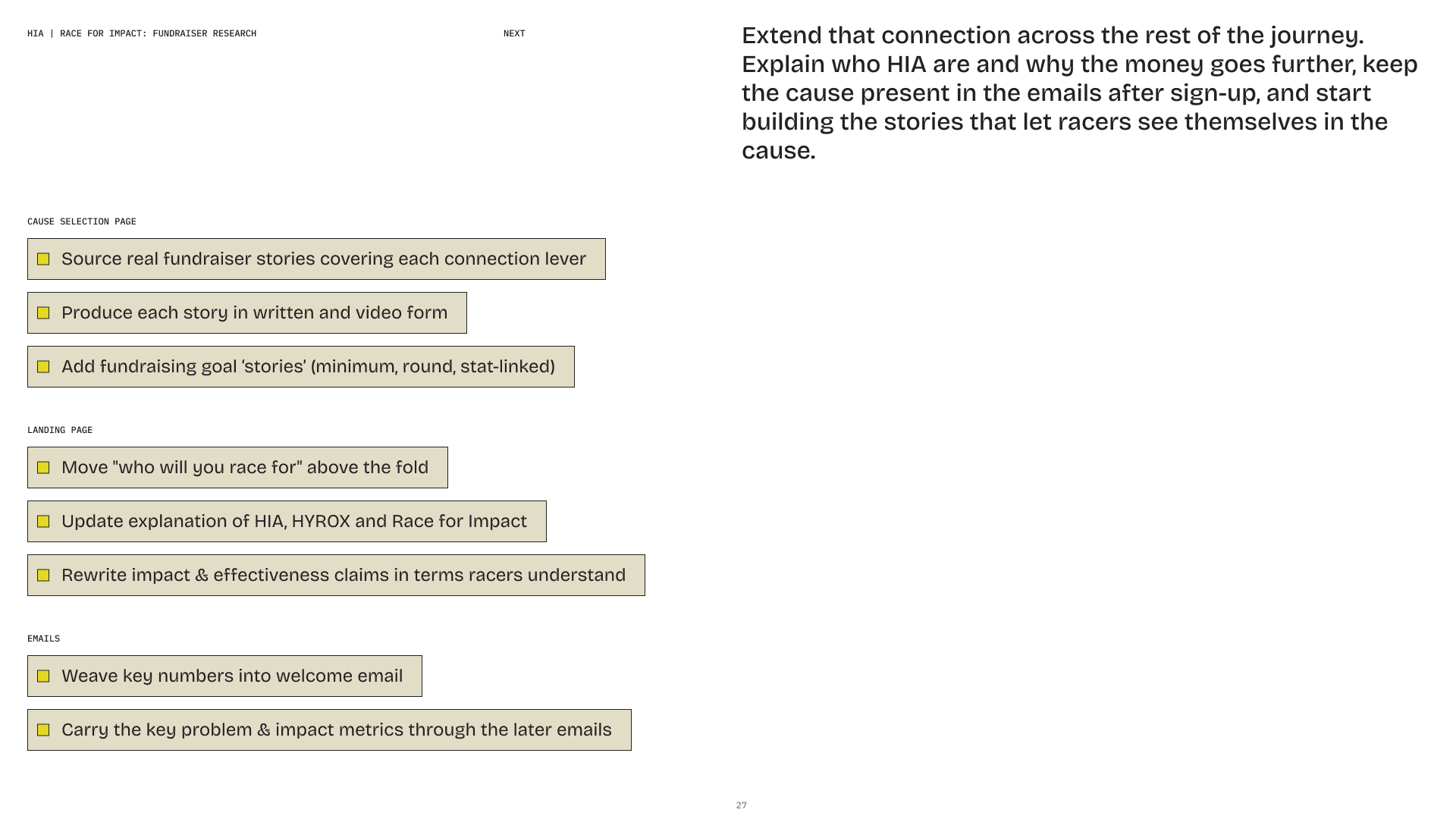
A practical framework — not a single-page fix — for how HIA communicates with fundraisers across every touchpoint: cause selection, onboarding, and post-race comms. The team is now applying and testing the recommendations directly.
Read the full research
The complete deck covers the audience model, all 18 assumptions and what the evidence said about each, the connection levers in full, and a roadmap of recommendations.
Download the deck